How Artificial Putting Green Installation Adds a Feature That Gets Used Every Day It Does Not Rain
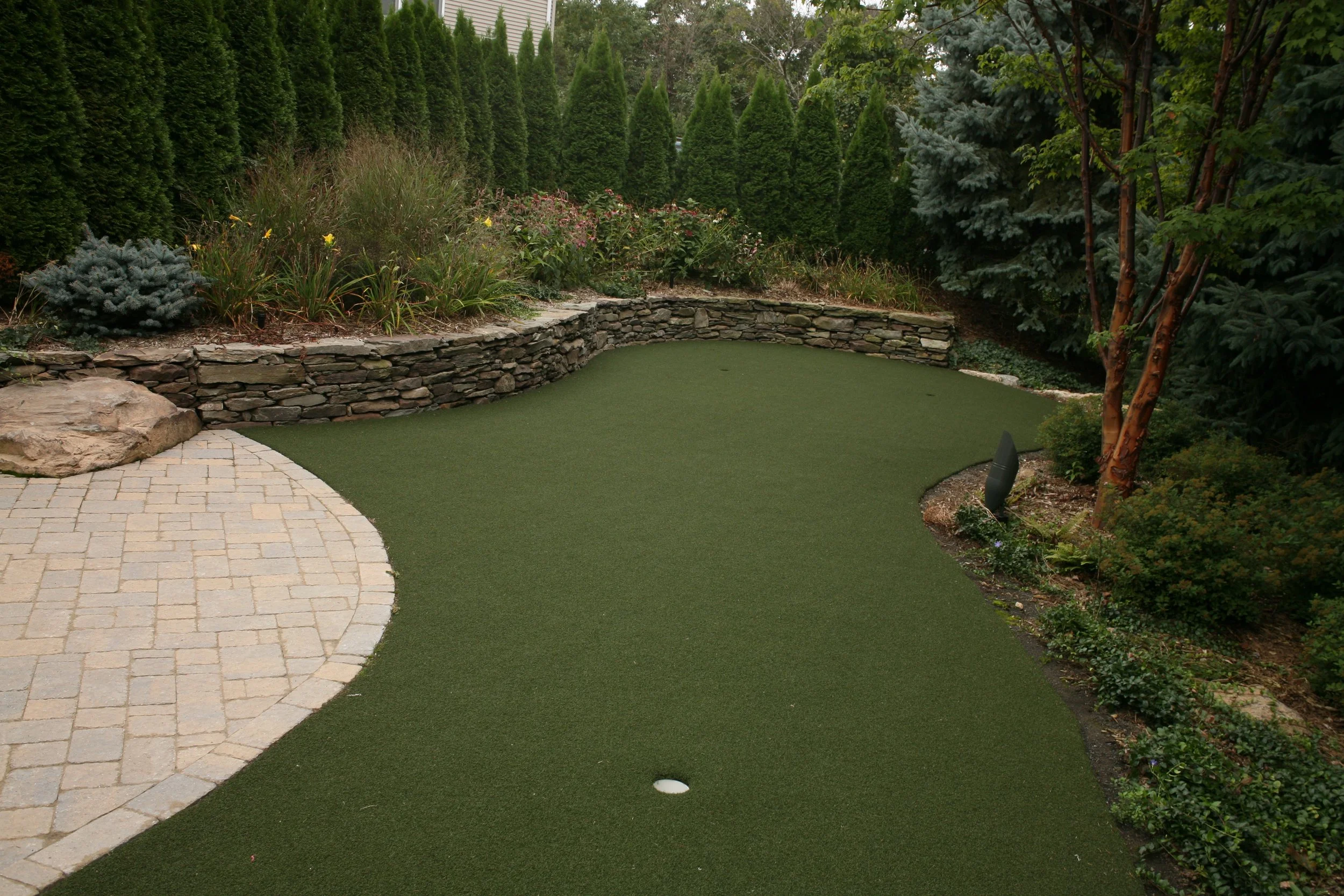
Most backyard features are seasonal. The pool opens in June. The fire pit earns its keep in October. The outdoor kitchen hosts dinners from May through September. The artificial putting green is different. It is usable from the first warm day in March through the last mild afternoon in December, and in Northern New Jersey, where the mild shoulder seasons extend well beyond the typical outdoor window, that translates into nine or ten months of daily use.
Artificial putting green installation creates a practice surface in the backyard that eliminates the drive to the course for a quick short game session, provides a recreational feature the family uses casually without changing clothes or reserving a tee time, and adds a design element to the landscape that, when installed correctly, looks as natural as the lawn it sits beside.
Related: The Art of Landscape Design in Ramsey, NJ, and Wyckoff, NJ
What Artificial Putting Green Installation Involves
A putting green is not a patch of artificial turf laid on the lawn. It is an engineered surface designed to roll at a specific speed, drain efficiently, and hold its contour through years of use and weather exposure.
A proper artificial putting green installation includes:
Excavation of the green area to a depth that accommodates the base layers, the drainage, and the turf system
A compacted aggregate base graded to the contours the homeowner and the installer design, including the subtle breaks, the slopes, and the undulations that make the green challenging and interesting to putt on
A drainage layer beneath the turf that prevents the water saturation that would soften the base and change the roll characteristics
The putting surface itself, a short pile synthetic turf with a nap direction that controls the speed and the break of the ball, selected for the roll quality rather than the visual appearance alone
A fringe of longer synthetic turf or a natural transition to the surrounding lawn that gives the green a finished edge and the option for chip shots from the perimeter
The contours are what make the green worth using. A flat surface with no break is boring within a week. A surface with subtle undulations, a ridge, a valley, a false front, provides the variety that keeps the homeowner coming back.
Related: Design a Playful Outdoor Space: Landscape Design Ideas for Active Families in Woodcliff Lake, NJ
How the Green Should Integrate With the Landscape
The artificial putting greens that look the most natural in Northern New Jersey are the ones designed as landscape features rather than sports installations. The green follows the existing grade rather than being elevated on a platform. The fringe transitions smoothly to the surrounding lawn or the planting beds. The bunker, if one is included, is positioned where the topography makes it feel like a natural feature rather than a novelty. And the landscape plantings around the green frame it without crowding the playing surface.
A green designed as part of the overall landscape plan coordinates with the patio, the walkways, the lighting, and the plantings in the surrounding space. A green dropped into the middle of the yard without design context looks like a carpet sample on the lawn.
The Feature That Earns Its Space Every Day
The putting green is the backyard feature with the highest frequency of use per square foot. Ten minutes before dinner. Twenty minutes on a Saturday morning. A quick session after work while the grill heats up. It does not require preparation, equipment beyond a putter and a few balls, or anyone else to participate. If your property in Mahwah, Ridgewood, or the surrounding communities has space for a green that integrates with the landscape rather than interrupting it, the installation conversation is where the short game moves home.
Related: Enhance Your Weekend Gatherings With a Custom Landscape Design and Landscaping in Oakland, NJ